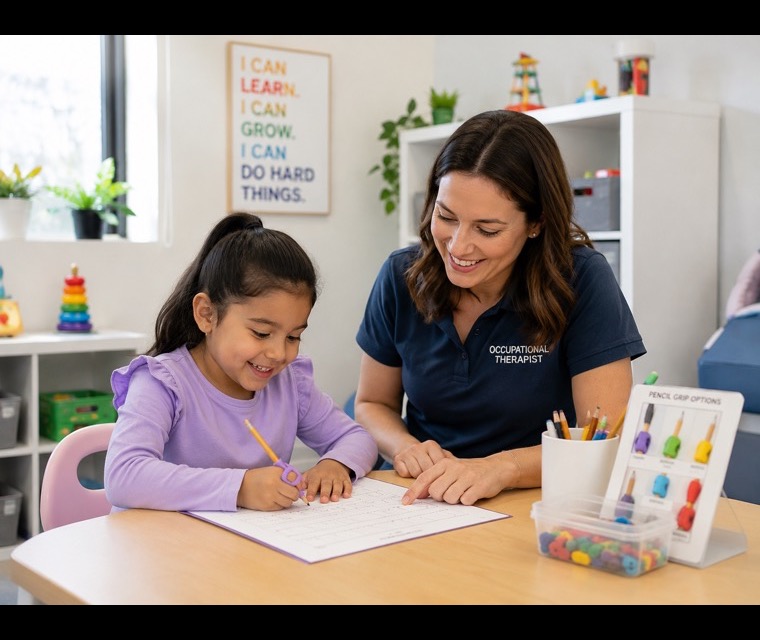
It's widely regarded as one of the most successful musical partnerships of all time. But it's eclipsed by the visual motor partnership between your eyes and your body.
What are visual motor skills?
Visual motor integration refers to the ability to act on the information you see. It's a complex skill set that requires the ability to:
Perceive visual input
Process information
Coordinate a motor response
Visual motor skills begin at birth and develop as a child's brain is stimulated through fine motor skills activities, like playing with building blocks, scribbling with crayons or learning to feed themselves.
Visual motor skills in action
If you walk into your hallway and see your stairs, your brain begins to prepare for climbing them. Your foot lifts, your hand reaches for the bannister and up you go.
It's the same when you brush your teeth, make a cuppa or create a Lego masterpiece. Your brain receives information from your eyes and prepares your body to move accordingly.
Note that visual motor skills are not the same as visual acuity (the ability to see clearly). It's possible to have excellent eyesight but poor visual motor skills.
Signs of poor visual motor integration
Kids who are struggling with visual motor integration may find it hard to:
- Stay within the lines when colouring in a picture
- Catch or kick a ball
- Write neatly
- Copy from the board
- Fasten buttons or tie shoelaces.
Essentially, they're not synching what they see with how they move.
It can look clumsy and messy, but it's not careless. These kids are often trying really hard. They may struggle with self esteem when they compare their best efforts to their peers.
Who is at risk of visual motor skills difficulties?
Anyone can experience visual motor skill difficulties, but they are more common among children with:
How do you improve visual motor skills?
Improving visual motor skills will usually involve occupational therapist or vision therapist support.
Your child's therapy may involve regular at home practice to improve vision skills, such as:
- Eye tracking
- Focusing
- Convergence
- Eye hand coordination
- Visual processing speed.
Occupational therapy is a very practical discipline that helps your child improve practical skills like:
- Handwriting
- Sports proficiency
- Managing daily life, getting dressed, playing, eating.
How can Country Therapy help?
Country Therapy's occupational therapists love to help children improve their visual motor integration. As this vital foundational ability improves, many other aspects of your child's life may also begin to improve, particularly their schooling.
We provide high quality occupational therapy services, liaise with your child's school, and write reports as necessary to help your child thrive.
We encourage local GPs and families to get in touch
GPs can refer patients directly, and families can contact us to book an appointment.
Make a referralAll information is general and is not intended to be a substitute for professional medical advice.
References
- Shrewsbury Public Schools, Activities for the development of visual motor skills in young children, schools.shrewsburyma.gov, [Accessed 21 February 2024]
- Carsone B, Green K, Torrence W, Henry B. Systematic Review of Visual Motor Integration in Children with Developmental Disabilities. Occup Ther Int. 2021 Jul 22;2021:1801196. doi: 10.1155/2021/1801196. PMID: 34381323; PMCID: PMC8321716, ncbi.nlm.nih.gov, [Accessed 21 February 2024]
- Optometrists Network, Visual motor integration, optometrists.org, [Accessed 21 February 2024]
- Spectrum News, Motor difficulties in autism explained, spectrumnews.org, [Accessed 21 February 2024]
- Cincinnati Children's, Brachial plexus injury, cincinnatichildrens.org, [Accessed 21 February 2024]
- Cerebral Palsy Guide, Occupational therapy for cerebral palsy, cerebralpalsyguide.com, [Accessed 21 February 2024]